
Start by describing what the car does
‘The car will not start’ can describe several different problems. The engine may not crank at all, may crank slowly, or may crank at normal speed without starting. These differences help narrow down the next checks.
Do not repeatedly hold the starter for long periods. Stop if you notice smoke, a burning smell or unusual electrical heat.
No sound or no crank
If the dashboard is dark and there is no response, the battery may be discharged or a main electrical connection may be poor. If the dashboard lights are bright but the engine does not crank, the cause may involve the starter circuit, gear-position switch, key recognition or another electrical fault.
Make sure an automatic vehicle is fully in Park. You can also try Neutral if the owner manual permits. For a manual vehicle, fully press the clutch. Check whether the steering lock or immobiliser indicator is behaving differently.
Slow cranking or repeated clicking
Slow cranking, dimming lights or repeated clicks often point toward low battery power or a poor battery connection, but a failing starter or charging problem can produce similar symptoms.
Do not assume the battery itself is the only issue. A battery may be flat because a light was left on, because the alternator is not charging correctly, or because the battery can no longer hold enough charge.
The engine cranks but does not start
When the engine turns at normal speed but does not run, possible causes include fuel delivery, ignition, sensors, security systems or engine-management faults. Running out of fuel or using the wrong fuel should also be considered.
Listen for unusual sounds and note whether the fault started after refuelling, heavy rain, recent repairs or a warning light. Avoid spraying starting fluid or changing parts without proper diagnosis.
Safe checks you can make
Check the fuel gauge, dashboard messages and whether the interior lights are unusually dim. Look for loose battery terminals only from a safe position, without touching damaged cables or leaking battery material. Try a spare key if the vehicle appears not to recognise the main key.
Jump-starting must follow the vehicle manufacturer’s instructions. Incorrect connections can damage electronics or cause injury, especially on hybrids, electric vehicles and vehicles with battery-management systems. Call for professional help when uncertain.
How a mobile mechanic diagnoses the fault
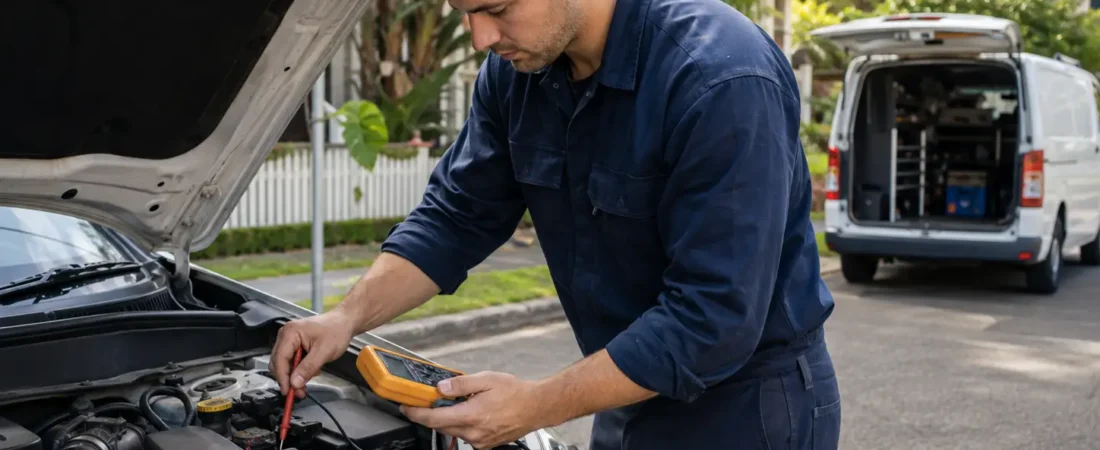
A mobile mechanic may test battery condition, charging voltage, starter operation, fuses and fault codes. The technician will combine the test results with the symptoms instead of replacing the first part that appears suspicious.
Some faults can be repaired immediately. Others require a specific part, deeper workshop testing or towing.
Get help at your location
If your car will not start at home, work or a safe roadside location, provide the vehicle details and describe exactly what happens when you try to start it. Mention any dashboard messages and recent work.
Mobile Roadside Mechanic assists customers across Sydney, Cabramatta, Fairfield, Liverpool, Campbelltown, Bankstown, Parramatta, Auburn, Blacktown, Penrith and St Clair.
Frequently Asked Questions
Does clicking always mean the battery is flat?
No. Low battery power is common, but poor connections, starter faults and charging-system problems can cause similar symptoms.
Can I keep trying to start the engine?
Avoid repeated long attempts. Stop if there is smoke, heat, a burning smell or an unusual mechanical sound.
Can a mobile mechanic diagnose a no-start fault?
Many battery, starter, charging and electronic faults can be assessed at the vehicle’s location.
Need a mobile mechanic?
Call Mobile Roadside Mechanic on 0422 987 222 or request a quote for repairs, diagnostics, servicing and roadside assistance at your home, workplace or safe roadside location.